The Best Race Engineers of F1 History
Last updated: 17/06/2026
“Box, box, box.” “Strat mode 4.” “Your tire degradation is optimal, head down.” For millions of Formula 1 fans, these radio transmissions are the definitive soundtrack of a Grand Prix weekend. Behind every legendary driver is an equally legendary voice sitting calmly on the pit wall.
Formula 1 is often viewed as a solitary pursuit, but the reality is quite different. When the visor goes down, the driver is constantly tethered to their garage by a single, critical lifeline. To win a World Championship, a driver needs more than raw pace and an aerodynamically dominant chassis. They need the best race engineer to decipher complex telemetry, manage race-day strategy, and act as a psychological anchor while navigating corners at 200 mph.
The synergy between a driver and their engineer can define an entire era of motorsport dominance. In this deep dive, we are looking back at the best race engineers of F1 history. We will break down what makes these trackside maestros so vital and highlight the iconic partnerships that have shaped the grid.
Key Takeaways
- The Voice of Reason: The elite pit-wall operators must balance heavy data analysis with emotional intelligence to keep drivers focused under intense pressure.
- Bono’s Benchmark: Peter Bonnington engineered Lewis Hamilton to six of his seven world titles, and is now mentoring Kimi Antonelli at Mercedes.
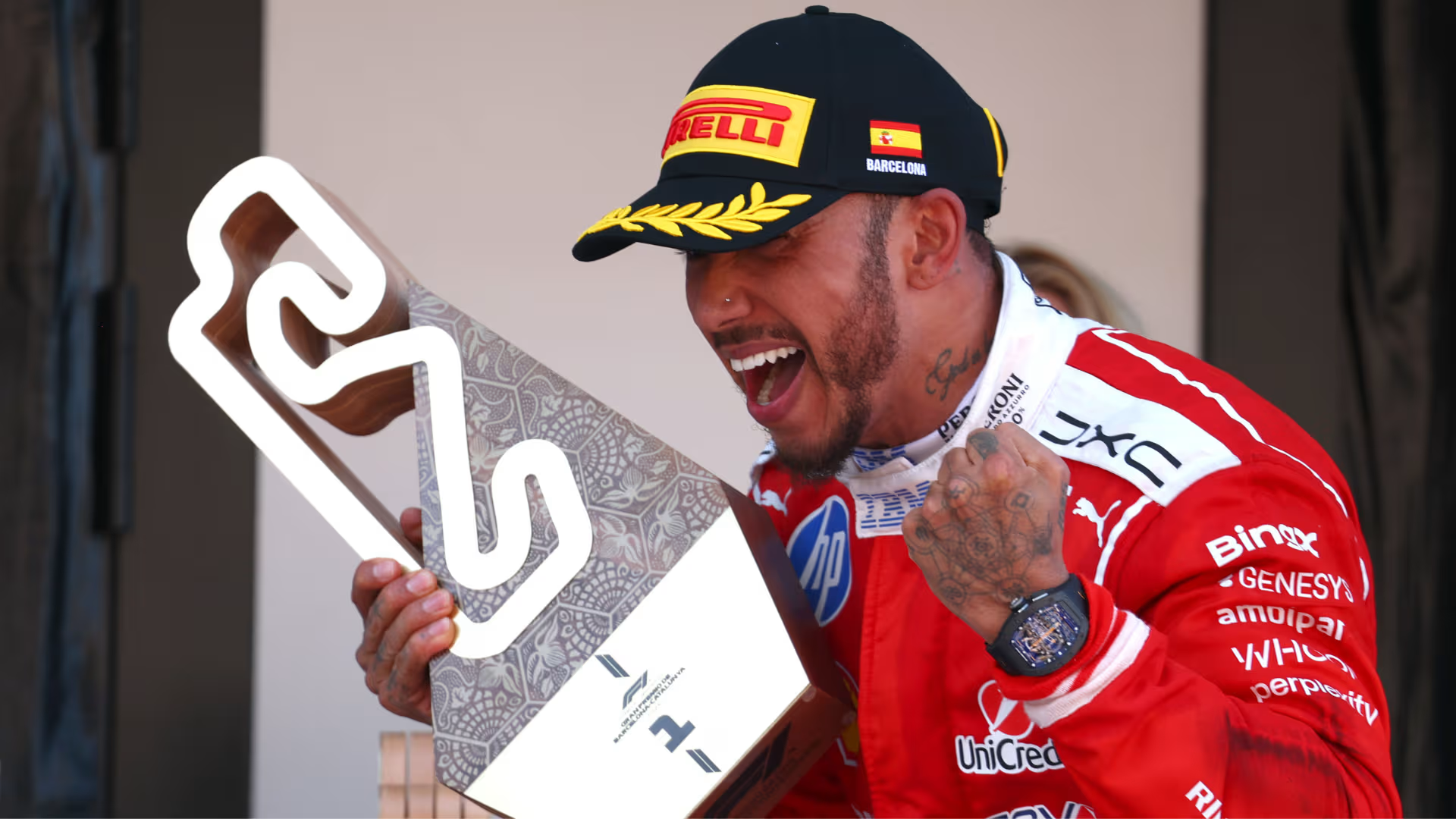
- The Italian Bono: In the 2026 season, Carlo Santi stepped up to guide Lewis Hamilton to a historic first victory for Scuderia Ferrari in Barcelona.
- The Unsung Heroes: Legends like Gianpiero Lambiase and Guillaume Rocquelin are the foundational masterminds behind Red Bull Racing’s historic eras of dominance.
What Defines the Best Race Engineer in Formula 1?
It is easy to assume that a trackside engineer’s only job is to read lap deltas and tire carcass temperatures. In reality, the role is infinitely more complex. The best race engineer acts as the definitive bridge between the driver’s visceral feeling in the cockpit and the engineering team’s mountain of wind-tunnel and track data.
During a Grand Prix, these engineers are monitoring hundreds of live sensors. They track energy clipping, battery deployment, brake wear, and the tactical movements of rival cars. Their true superpower is rapid communication. They must condense all of that heavy telemetry into bite-sized, actionable instructions without overloading the driver’s cognitive capacity.
Team Principals look heavily for emotional intelligence. Mercedes boss Toto Wolff perfectly described this dynamic in 2026, stating that an elite engineer must be “nerdy when he needs to be nerdy” but also “super compassionate when the driver needs support.” Managing a driver’s ego, frustration, and anxiety during a high-stakes title fight is an absolute art form.
The Greatest Partnerships: The Best Race Engineers on the Grid
Let’s examine the trackside masterminds who have secured their places in the Formula 1 history books, dictating strategy and shaping World Champions.
Peter “Bono” Bonnington (Mercedes)
No conversation about the best race engineers is complete without Peter Bonnington. Better known to the motorsport world simply as “Bono,” he is the architect behind the famous “It’s hammertime” radio call. Bonnington engineered Lewis Hamilton to six of his seven World Championships during the Mercedes hybrid era, cementing an unbreakable bond built on mutual trust.
Bonnington’s technical acumen was honed over decades; he started as a data engineer with Jordan Grand Prix in 2004 before moving to Honda and Brawn GP. When Hamilton departed for Ferrari in 2025, many assumed Bono would follow. Instead, he stayed at Brackley, stepping into the role of Head of Trackside Performance.
In the 2026 season, Bonnington took on the monumental task of mentoring the team’s teenage prodigy, and a potential superstar, Kimi Antonelli. Transitioning from a veteran champion to a rookie requires immense adaptability. By guiding Antonelli to multiple Grand Prix victories in 2026 and a championship lead, Bono has unequivocally proven that his generational talent is not reliant on a single driver.
Gianpiero “GP” Lambiase (Red Bull Racing)
If Bono is the calming, supportive presence, Gianpiero Lambiase is the firm, no-nonsense truth-teller. As Max Verstappen’s race engineer, “GP” is famous for his blunt, often fiery radio exchanges with the reigning World Champion. Lambiase understands that Verstappen doesn’t need emotional coddling; he requires precise data and occasional pushback.
Their mid-race bickering frequently sounds like an old married couple, but the competitive results speak volumes. Their communication loop is brutally efficient. GP knows exactly how much strategic information Verstappen can process while defending an apex at maximum speed. By effectively acting as Verstappen’s trackside mirror, GP ensures that the Dutch champion remains in his optimal operating window, making him the definitive best race engineer of the modern ground-effect era.
Rob Smedley (Scuderia Ferrari & Williams)
If you want to understand the pure emotional depth a race engineer can bring to a driver, look no further than the legendary bond between Felipe Massa and Rob Smedley. Their partnership at Ferrari transcends pure data analysis, standing as arguably the most affectionate and fiercely loyal driver-engineer relationship in Formula 1 history.
Smedley took over as Massa’s race engineer in 2006, immediately transforming the Brazilian’s confidence and unlocking his championship-caliber pace. He wasn’t just managing the car’s differential settings; he was managing Massa’s mindset. Smedley gave the sport some of its most iconic radio moments, from the comforting “Felipe baby, stay cool” at Malaysia in 2009, to the heartbreakingly stoic execution of the “Fernando is faster than you” team order at Hockenheim in 2010.
Their synergy was so absolute that when Massa moved to Williams in 2014, Smedley followed him over to Grove to head up vehicle performance. Smedley’s ability to act as part trackside mastermind, part protective older brother proved that the best race engineers don’t just tune a car – they protect their driver’s spirit through the highest highs and lowest lows of the sport.
Guillaume “Rocky” Rocquelin (Red Bull Racing)
Before GP and Verstappen, there was Rocky and Sebastian Vettel. Guillaume Rocquelin was the strategic mastermind behind Vettel’s four consecutive World Championships from 2010 to 2013. Rocky managed a highly complex Red Bull chassis that required specific, unnatural driving techniques to maximize exhaust gases over the rear diffuser.
During their championship run, Rocky was the perfect counterbalance to Vettel’s youthful exuberance. His incredible tactical awareness kept Vettel’s emotions in check during highly tense title battles against Fernando Alonso. Rocky’s iconic “You just wait sunshine” radio messages are etched into F1 folklore, setting the blueprint for how a race engineer can actively shape a driver’s championship campaign.
Andrea Stella (Ferrari, McLaren)
Long before he became the brilliant Team Principal of McLaren, Andrea Stella was widely regarded as one of the best race engineers on the grid. He famously served as a performance engineer for Michael Schumacher during the peak of Ferrari’s dominance. Stella later transitioned to Kimi Raikkonen, helping the Finn secure his 2007 World Championship.
Stella’s meticulous, academic approach to car setup perfectly complimented Raikkonen’s natural, feel-based driving style. When Fernando Alonso joined Ferrari, Stella became his race engineer, managing the Spaniard through two agonizingly close championship battles. Stella’s deep technical knowledge and elite man-management skills across three distinct World Champions prove his generational talent.
People Also Ask (FAQ)
Who is the most famous F1 race engineer?
Peter “Bono” Bonnington is arguably the most famous race engineer in Formula 1 history. His long-standing partnership with Lewis Hamilton at Mercedes produced six World Championships, making his distinctive voice instantly recognizable to millions of fans globally.
How do you become an F1 race engineer?
Becoming an elite F1 race engineer requires years of intense academic and practical work. Most begin with a specialized degree in mechanical, automotive, or aerospace engineering. From there, candidates usually work their way up through junior motorsport categories (like F3 and F2) as data analysts or performance engineers before finally securing a coveted seat on an F1 pit wall.
Do race engineers travel to every Grand Prix?
Yes, race engineers travel with the core team to every single Grand Prix on the calendar. However, teams also utilize a “remote garage” at their headquarters, where backup engineers analyze real-time data to support the trackside crew. For example, Ferrari’s Carlo Santi spent years in the Maranello remote garage before returning to the pit wall to engineer Lewis Hamilton in 2026.