2026 F1 Steering Wheel Explained
Last updated: 11/05/2026
Key Takeaways
-
- Engineering Marvel: Modern F1 steering wheels are bespoke minicomputers costing up to $100,000 each.
- Real-Time Strategy: Drivers make dozens of adjustments per lap, from brake bias to differential locking, while traveling at 200 mph.
- Technical Comparison: We examine the 2024 Daniel Ricciardo VCARB wheel and the 2021 Lewis Hamilton Mercedes-AMG wheel layouts.
- Cognitive Load: Mastering these interfaces takes years of practice to turn complex diagnostics into pure muscle memory.
When you watch a Grand Prix, your eyes are naturally drawn to the blur of carbon fiber and the screech of tires. However, the most sophisticated piece of technology isn’t under the engine cover, it’s in the driver’s hands. An F1 steering wheel is the only interface between a world-class athlete and a $15 million machine, acting as the nerve center for every strategic and mechanical adjustment made during a race.
To understand the sheer complexity of these devices, we are looking at the intricate details of two specific steering wheels: the 2024 Daniel Ricciardo VCARB wheel and the 2021 Lewis Hamilton Mercedes-AMG wheel. By synthesizing data from these two pieces of engineering, we can decode how a driver manages a car’s entire ecosystem at 200 mph. From managing thermal degradation to recalibrating engine maps, every thumb flick is a high-stakes calculation.test
The $100,000 Minicomputer: Why Does the Steering Wheel Cost So Much?
You won’t find a price tag on these in a retail store, but a single F1 steering wheel costs roughly $60,000 to $100,000. This astronomical figure isn’t just about the “F1 tax”; it is a reflection of the aerospace-grade materials and bespoke electronics housed within the frame. Every wheel is a lightweight carbon fiber shell, custom-molded to the specific anatomy of the driver’s hands to ensure perfect ergonomics under high G-loads.
Beyond the shell, the wheel is essentially a high-performance minicomputer. It utilizes a CAN bus (Controller Area Network) system to communicate with the car’s Central Control Unit (CCU). This allows for thousands of data points to flow bidirectionally, telemetry from the car travels to the driver’s LCD screen, while driver inputs travel back to the power unit and gearbox instantly.
The manufacturing process is grueling, involving hundreds of hours of hand-soldering and rigorous stress testing. Every button and rotary must be tactilely distinct so the driver can feel the “click” through fireproof Nomex gloves. In the high-vibration environment of a cockpit, the reliability requirements are more akin to a fighter jet than a traditional automobile.
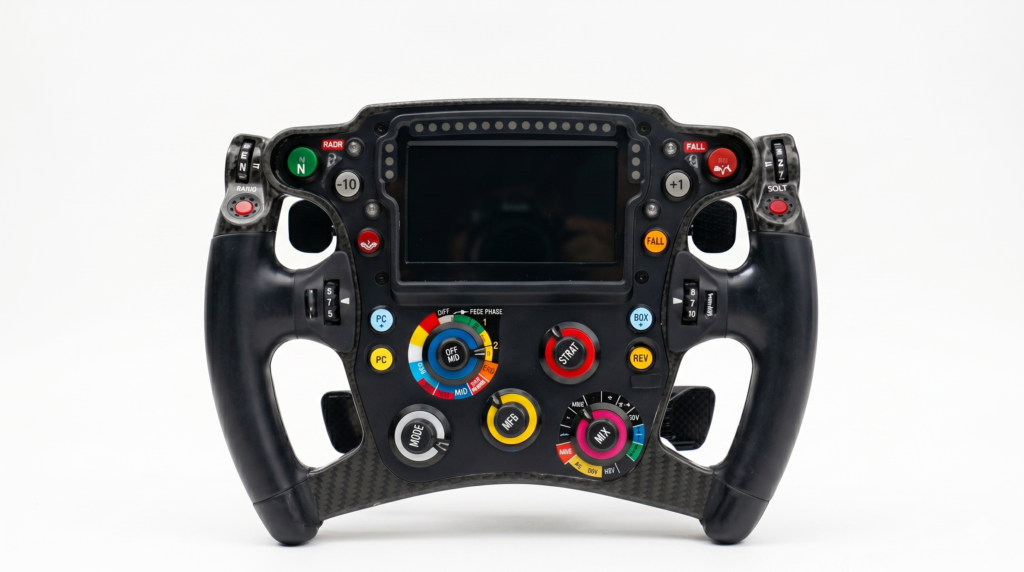
Replica of the $100,000 “minicomputer”: A detailed look at Daniel Ricciardo’s 2024 VCARB F1 steering wheel.
Mastering the Front of an F1 Steering Wheel
The front of the F1 steering wheel is a crowded landscape of rotaries and buttons designed for immediate performance shifts. On Ricciardo’s 2024 VCARB wheel and Hamilton’s 2021 Mercedes, the most critical adjustments involve the Differential (Diff) and Brake Bias. These settings determine how the car handles the “geometry” of a corner, and they are adjusted dozens of times per lap.
The Differential (Diff) Entry rotary is a driver’s best friend for curing handling imbalances. By turning this dial, the driver adjusts how much the rear wheels are “locked” together during the entry phase of a turn. A higher number increases locking, providing stability if the rear end is stepping out (oversteer), while a lower number “opens” the diff to help the car rotate if it feels sluggish (understeer).
Brake Bias is arguably the most dynamic setting in the cockpit. Drivers use dedicated Plus (+) and Minus (-) buttons to shift the braking force toward the front or rear axles. As fuel burns off and the car gets lighter, or as tires begin to “grain,” the driver must shift this balance to prevent front-wheel lockups or rear-end instability.
On the Mercedes wheel used by Hamilton, we also see Brake Migration rotaries. This is a highly technical setting that changes the brake balance during the braking event itself. It allows the car to have a different balance at the start of the braking zone versus the apex, maximizing stopping power without compromising corner-entry stability.
Mid-Race Diagnostics and Default Codes
One of the most frustrating aspects for a driver is the Driver Default system. Modern F1 cars are covered in hundreds of sensors, and if one fails, it can send the car into a “limp mode.” To prevent a DNF, the race engineer will communicate a specific code to the driver over the radio.
On the 2024 VCARB wheel, Ricciardo used a combination of -10 and +1 buttons to input these codes. If told to execute “Fail 23,” the driver hits the 10 button twice and the 1 button three times before hitting the Fail/Confirm button. This effectively “talks” to the car’s software, telling it to ignore a faulty sensor or switch to a backup map.
These buttons are also used for Shift Modes. During an out-lap or under a Safety Car, the engineer might request a more conservative shift pattern to protect the gearbox while temperatures are low. Once the green flag drops, the driver uses the input buttons to unlock the “Quick Shift” modes that provide the seamless, millisecond gear changes F1 is known for.
Strategic Communication
Communication is a two-way street, and the F1 steering wheel facilitates this through several non-verbal buttons. The Pit Confirm button is used by drivers to acknowledge a “Box, Box” instruction without having to speak. This is vital during high-intensity moments where breathing and concentration are more important than talking.
The Marker button is another specialized tool for the engineering team. If a driver feels a strange vibration or a momentary “hiccup” in power, they hit the marker. This places a digital flag in the telemetry stream, allowing the data scientists back at the factory to pinpoint that exact millisecond and diagnose the issue later.
Then, there is the Overtake button, often the most famous control on the wheel. When pressed, the car’s Power Unit instantly deploys its maximum hybrid energy from the ERS and switches to the most aggressive fuel map. It is the ultimate “attack” mode, used either to execute a pass on a straight or to defend against a rival using DRS.
The Back Side of a Formula 1 Steering wheel
The back of the wheel is where the most physical work happens. Every steering wheel features gear-shift paddles, upshift on the right, downshift on the left. Most wheels, including Ricciardo’s and Hamilton’s, utilize dual clutch paddles for ergonomic flexibility.
These dual paddles do the same thing, but they allow the driver to operate the clutch with either hand depending on the steering angle. This is crucial during pit entrys/exits where the driver’s hands might be crossed. Only one paddle is needed to find the “bite point” for a race start, but having two ensures the driver is never caught out of position.
In the pre 2026 versions, we also saw the DRS paddle on the rear of the steering wheel.
Precision Calibrations
Small details on the wheel can have massive consequences, such as the Tire Dial. Drivers must manually set this dial to match the tire compound they are currently running (Dry, Intermediate, or Wet). This isn’t just for data logging, it actually calibrates the car’s speed calculations.
Because wet tires have a slightly different diameter (due to the tread) than slicks, the car’s speed sensors can be slightly off. If the tire dial is set incorrectly, the Pit Lane Speed Limiter might miscalculate the car’s speed. In a sport where being 1 km/h over the limit results in a penalty, this tiny dial is the difference between a podium and a drive-through penalty.
The Pit Limiter itself is a simple button, usually colored yellow or white. Once pressed, the car’s ECU limits the engine’s RPM to ensure the car stays exactly at 60 or 80 km/h. It’s a moment of relative “rest” for the driver, though they still have to navigate a crowded pit lane while checking their mirrors for merging traffic.
The Human Element
Despite the digital nature of the F1 steering wheel, it still caters to the driver’s biological needs. The Drink button (or manual tube) is a lifeline during grueling races like Singapore or Qatar. As Ricciardo noted, the fluid in the car’s “drinks bag” sits near the hot electronics and engine, meaning by the end of the race, the driver is essentially sipping “disgusting hot tea.”
Managing all of this requires a level of cognitive processing that is hard for a casual fan to fathom. Drivers aren’t just steering; they are monitoring tire pressures, brake temps, and fuel delta, all while listening to an engineer and fighting G-forces. Ricciardo admits that it takes years to reach a state of “autopilot” where these adjustments become muscle memory.
The evolution from the 2021 Mercedes wheel to the 2024 VCARB design shows a trend toward better button placement and more intuitive software interfaces. However, the core challenge remains: the wheel is a high-bandwidth data tool that demands 100% of a driver’s focus. Mastering the steering wheel requires the effort not only from a driver, but from the whole F1 team.
People Also Ask (FAQ)
Why are F1 steering wheels so expensive?
F1 steering wheels are custom-built using aerospace-grade carbon fiber and bespoke electronics. They function as high-performance minicomputers capable of processing thousands of data points per second.
How many buttons are on an F1 steering wheel?
Typically, there are between 20 and 30 buttons, switches, and rotary dials, each serving a specific mechanical or strategic purpose, such as adjusting brake bias or communicating with the pits.
Are all steerings wheels the same?
No, every steering wheel is different. Those minicomputers are highly customized with each button catering to the specific drivers’ needs. Teams and drivers spend many hours during simulations to fine-tune the steering wheel.