What is the F1 Cost Cap and how did it transform the sport
Last updated: 20/07/2026
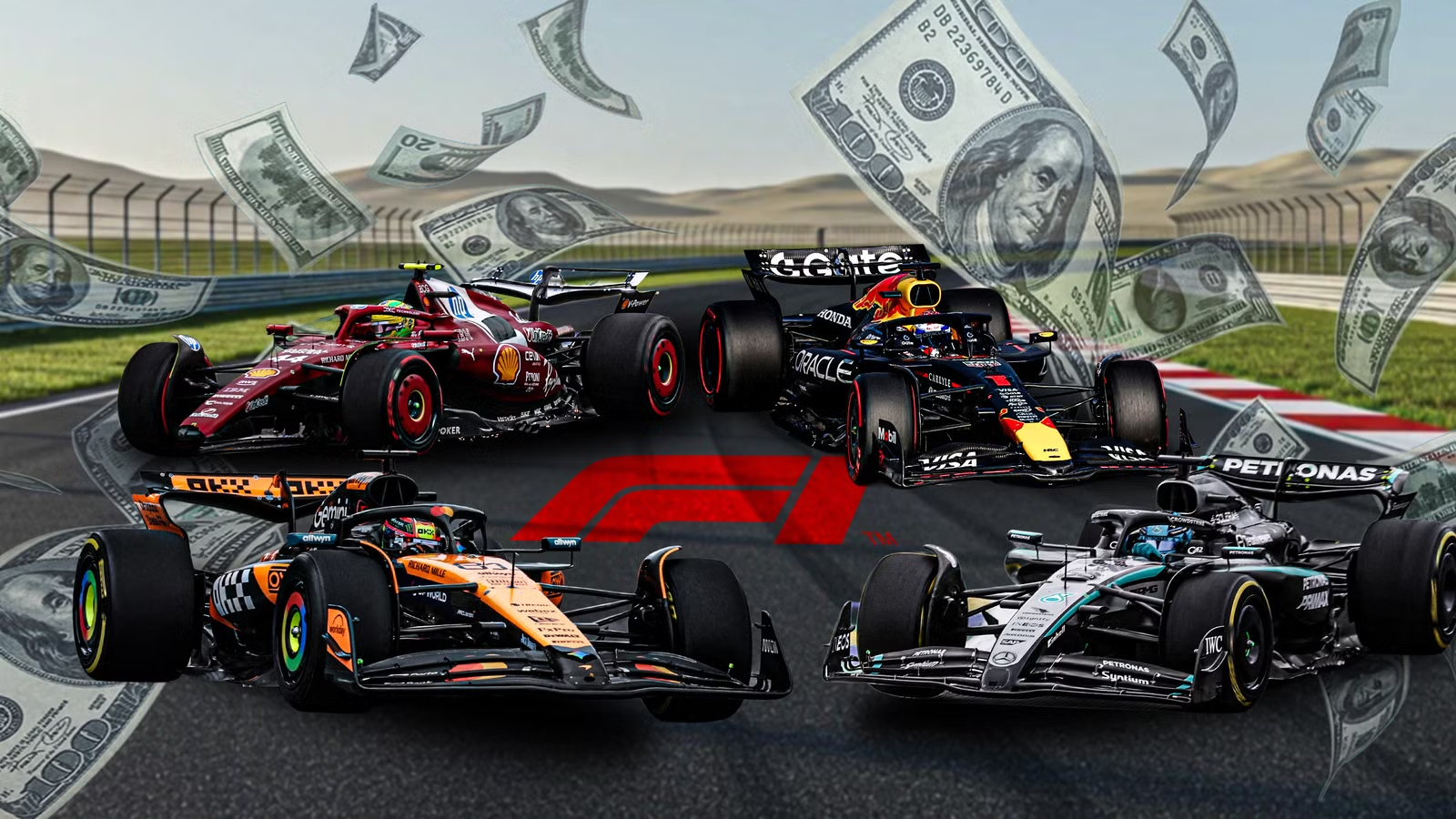
For decades, Formula 1 was dominated by a simple, brutal formula: the constructor with the deepest pockets won the World Championship. Before the modern financial era, spending across the grid was completely unregulated, allowing the richest teams to buy the best engineering talent, invest heavily in cutting-edge technology, and build vastly superior facilities. This unchecked spending arms race had a direct, undeniable impact on track performance, leaving smaller independent teams fighting just to keep their factory doors open. However, the introduction of the F1 Cost Cap fundamentally transformed the sport, turning it from a billionaire’s money pit into a highly lucrative, self-sustaining franchise model.
As Formula 1 is in the midst of a regulatory shift, the financial rules are more critical than ever. The base operational cap has increased to $215 million, reflecting inflation and a strict tightening of accounting perimeters rather than a true spending spree. So, what exactly is the cost cap in F1, how are the boundaries policed, and why did this single financial regulation trigger a historic surge in team valuations?
The Business Problem: Why F1 Needed Financial Regulations
Formula 1 represents one of the most significant regulatory shifts in elite sport. Between 2021 and 2026, the cost cap evolved from an emergency financial parachute into a strategic framework that dictates how teams allocate resources, develop their aerodynamic packages, and plan for future seasons. The original cost cap for the 2021 season was initially set at $175 million. However, the devastating economic impact of the COVID-19 pandemic forced stakeholders to revise this figure down to $145 million before the season even began.
The aim was clear from the outset: to reduce the enormous financial disparities between teams, ensure long-term financial stability, and create a more competitive environment on the grid. This mechanism is not uncommon in the wider business of elite sports. The National Football League (NFL) and National Basketball Association (NBA) operate salary caps to limit how much a franchise can spend on players. In Formula 1, the car itself acts as the primary performance differentiator, making a budget cap the motorsport equivalent of a player salary cap.
To force efficiency, the limit was gradually tightened. In 2022, alongside the introduction of ground-effect technical regulations, the cap was lowered to $140 million. It then reached its planned minimum of $135 million in 2023, a figure that remained the baseline through 2024 and 2025, albeit with inflation adjustments.
Key Takeaways
- Leveling the Playing Field: The cap was introduced in 2021 to reduce the advantage of the biggest-spending teams and support a more competitive grid.
- Performance Focus: The limit strictly covers a team’s expenditure that relates directly to the race car’s performance.
- The 2026 Baseline: The overall cap has increased to $215 million for 2026, driven by cumulative inflation and the inclusion of previously uncapped costs.
- Power Unit Controls: Engine manufacturers are governed by a separate power unit cost cap, rising to $190 million in 2026.
How the Cost Cap in F1 Actually Works
The defining principle of the cost cap in F1 is that it covers spending that directly influences car performance. This perimeter includes research and development, aerodynamics, race operations, testing, and the majority of factory staff salaries. Every aerodynamic upgrade designed in the wind tunnel and manufactured to reduce lap time falls strictly within the audited budget.
However, Formula 1 is a global marketing juggernaut. To ensure teams could still operate as premium global brands and retain their superstar appeal, several major expense categories were intentionally excluded from the operational cap. The rulebook currently carries roughly 20 to 25 exclusions.
The most notable exclusions from the F1 cost cap include:
- Elite Salaries: Driver pay and retainers, as well as the salaries of the three highest-paid team members (typically the Team Principal and Chief Technical Officer), are completely exempt.
- Commercial and Administrative Costs: Legal, HR, finance, marketing, and hospitality operations sit outside the cap.
- Travel and Logistics: Race travel costs are excluded to account for the massive logistical undertaking of a global calendar.
- Employee Well-being: Health and safety costs, along with catering expenses at both the factories and race events, are newly excluded for 2026.
- Brand History: Costs related to heritage car programs are ignored by the cap.
The 2026 Reshuffle: Understanding the $215 Million Era
For 2026, the FIA lifted the headline cap limit from $135 million to $215 million. While a casual observer might view an $80 million jump as a return to an unregulated spending war, the FIA’s financial regulations chief, Federico Lodi, emphasizes that this is a recalculation rather than an allowance for extra spending.
The jump primarily reflects cumulative inflation since 2021 being formally rolled into the baseline number. More importantly, costs that used to sit outside the perimeter are now being aggressively counted inside. For instance, the separate capital expenditure cap, which previously allowed teams a budget of $36 million over a rolling four-year period for infrastructure like new wind tunnels, has been scrapped. Instead, the annual depreciation costs for those massive infrastructure projects are now included directly within the main $215 million operational cap.
Additionally, the FIA has tightened loopholes regarding staff allocation. Previously, teams could split an engineer’s salary if they worked on non-F1 side projects. Now, if an employee spends any time at all on F1-related projects, their entire cost must be counted as 100% F1 expenditure. The regulations also feature built-in concessions to accommodate a growing grid. With Cadillac joining as the 11th team in 2026, the financial ecosystem has expanded. Furthermore, there is a specific allowance mechanism for teams employing staff in high-cost jurisdictions, a vital concession for Audi as they base their operations in Switzerland following their takeover of Sauber in Hinwil.
The Power Unit Cap: Stopping an Engine Arms Race
Aerodynamics is only half the battle. F1 also runs a completely separate cost cap dedicated entirely to power units. Introduced in 2023, this parallel budget controls how much manufacturers can spend on developing, building, and supplying hybrid engines. The engine cap was initially set at $95 million plus inflation per year for 2023, 2024, and 2025.
For the highly complex 2026 engine regulations, this limit has been increased to $190 million to cover the vast manufacturing and support costs required to supply these new hybrid units on track. To ensure fresh blood can enter the sport competitively, new manufacturers receive specialized allowances. For any future new manufacturer, the limit was increased to $148.5 million for the three years preceding their official entry, helping them get up to speed from a standing start. The objective remains identical to the chassis cap: stop a spending arms race and keep massive automotive manufacturers in check as engine technology shifts.
The Franchise Model: Skyrocketing Team Valuations
From a corporate perspective, the most dramatic impact of the F1 cost cap has occurred entirely off the track. By definitively limiting expenditure, Liberty Media completely eliminated the threat of unlimited operating losses. This regulatory ceiling transformed the grid’s reputation. Formula 1 teams shed their historical label as “trophy assets”, notorious for being the fastest way to turn a billion-dollar fortune into mere millions and became highly investable, franchise-like entities.
Because overall spending is now capped, scarcity value acts as a massive financial multiplier. There are only 11 teams on the F1 grid, compared to 32 NFL franchises, 30 NBA teams, and 20 Premier League football clubs. This enforced scarcity, combined with surging global popularity driven by social media, US expansion, and the Netflix Drive to Survive series, has caused valuations to skyrocket.
Real-world transactions provide concrete proof of this business revolution. Just over five years ago, Canadian billionaire Lawrence Stroll purchased the defunct Force India team out of administration for £90 million. He rebranded the outfit to Aston Martin F1, secured massive sponsorships like Saudi state oil company Aramco, and invested in a state-of-the-art headquarters at Silverstone. By late 2023, Stroll successfully sold a minority stake in the team to US investment house Arctos Partners at a total valuation north of £1 billion.
The Marketing Upside: Predictability is Bad for Business
For broadcasters, sponsors, and global marketers, predictability is the enemy of engagement. The fundamental intent behind the F1 cost cap was to balance cost control with competitive fairness, ensuring teams have genuine opportunities to close performance gaps. Under the old system, a midfield team mathematically could not afford to out-develop legacy giants over a nine-month calendar.
While fan perception can sometimes be skeptical, viewing private jets, yachts, and road car projects as potential loopholes, the FIA defends the financial system as largely “self policing” over time. The threat of draconian sporting penalties for breaching the cap forces extreme compliance. The result is a highly compressed, fiercely competitive grid where financial might is no longer an absolute guarantee of a podium finish. Ultimately, the cost cap has not just leveled the sporting playing field; it has engineered the long-term commercial dominance of the world’s fastest sport.
People Also Ask (FAQ)
What happens if a team breaches the F1 Cost Cap?
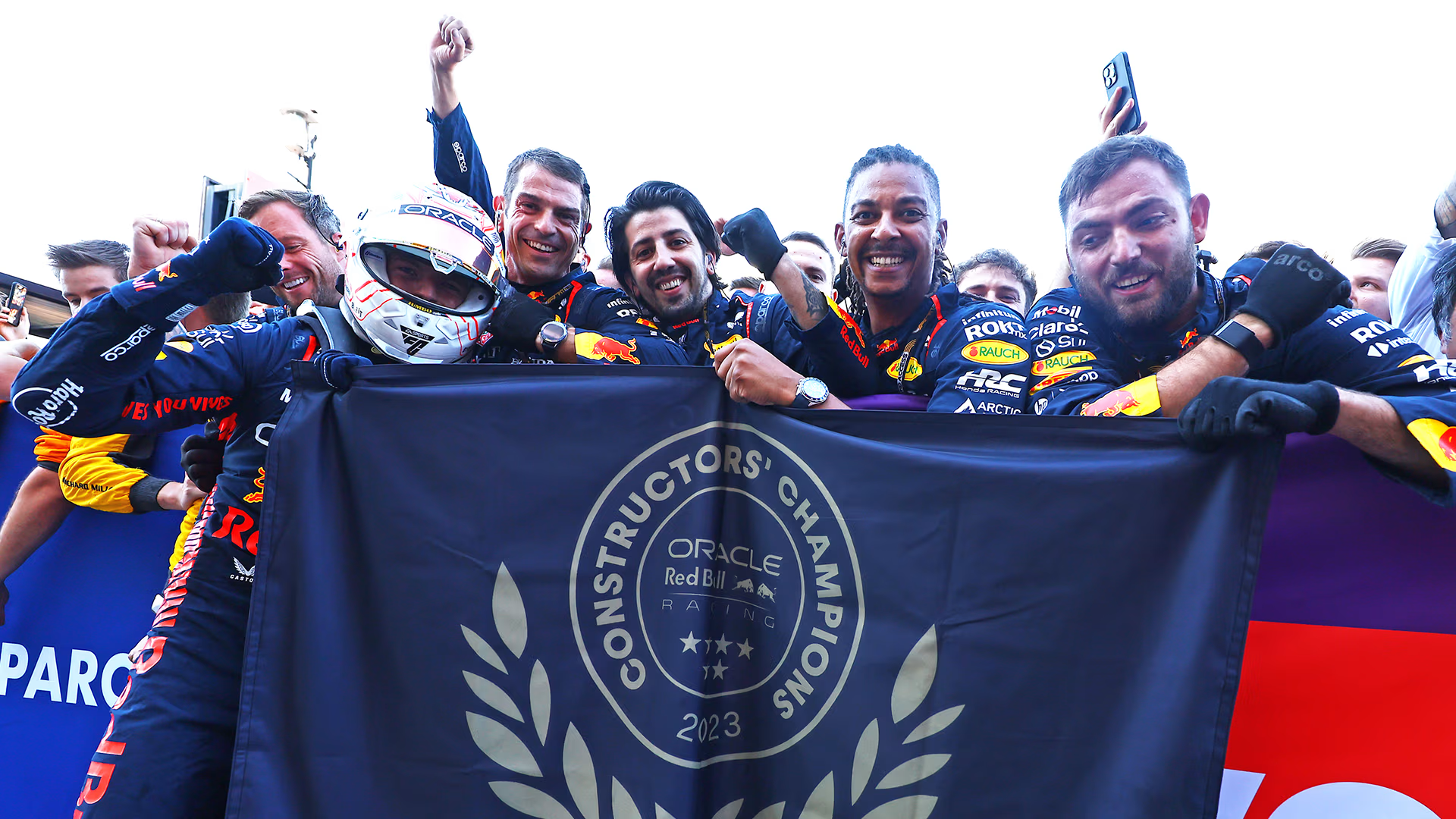
Teams that exceed the spending limits face severe sporting and financial penalties. For example, in 2021, Red Bull Racing exceeded the cap by $2.6 million. As a result, the team received a $7 million fine and a 10% reduction in their aerodynamic testing time for the 2023 season. Aston Martin and Williams were also penalized with fines in 2021 for procedural breaches related to late or misfiled paperwork.
Are driver salaries included in the F1 cost cap?
No, driver salaries and retainers are strictly excluded from the operational F1 cost cap. The budget limit is designed to control performance-related expenditure, meaning teams can still pay unlimited premium wages to retain superstar talent on the grid. Additionally, the salaries of the team’s three highest-paid staff members, which usually include the Team Principal and Chief Technical Officer, are also fully exempt from the limit.
How much is the F1 cost cap in 2026?
For the 2026 Formula 1 season, the baseline operational cost cap has been increased to $215 million. While this looks like an $80 million jump from the previous $135 million base, it is not a true allowance for extra spending. The new figure is roughly neutral overall, as it now rolls in cumulative inflation and includes massive expenses, such as annual infrastructure depreciation and capital expenditure, that were previously kept outside the cap.