
Preview: The 2026 Chinese Grand Prix
Last updated: 09/03/2026
The 2026 Chinese Grand Prix arrives early in the season, but it already carries immeasurable importance. As the second round of the championship and the first sprint weekend of the year, the 2026 Chinese GP will reveal far more about the competitive order than the opening race in Australia.
Shanghai’s unique mix of long straights, tightening corners and brutal front-tyre wear has historically exposed weaknesses in both cars and strategies. That dynamic becomes even more important under the new 2026 technical regulations, where energy deployment and aerodynamic efficiency could decide the race before the first pit stop.
Below is a detailed preview of the Chinese weekend at the Shanghai International Circuit, including the schedule, track analysis, technical challenges and the strategic battles likely to shape the race.
2026 Chinese Grand Prix schedule: What time is each session in the U.S.?
The 2026 Chinese Grand Prix runs from March 13th to March 15th at the Shanghai International Circuit and features the sprint format. The main race is scheduled for 56 laps.
All times below are U.S. Eastern Time (ET).
- Free Practice 1 – March 12th 11:30 PM
- Sprint Qualifying – March 13th, 3:30 AM
- Sprint Race – March 13th, 11 PM
- Qualifying – March 14th 3 AM
- Race – March 15th, 3AM
The sprint format dramatically compresses preparation. Teams get only one practice session before sprint qualifying, forcing engineers to rely heavily on simulation models.
That lack of track time matters more in Shanghai than at many circuits because tyre behaviour and energy deployment are notoriously difficult to predict here.
Chinese GP history: Last five race winners and recent sprint winners
Understanding recent history at the Shanghai Circuit helps explain the strategic approach teams will bring into the weekend.
Last Five Chinese Grand Prix winners
- 2025 – McLaren – Oscar Piastri
- 2024 – Red Bull – Max Verstappen
- 2019 – Mercedes – Lewis Hamilton
- 2018 – Red Bull – Daniel Ricciardo
- 2018 – Mercedes – Lewis Hamilton
Oscar Piastri dominated the 2025 race from pole position, leading a McLaren one-two with Lando Norris.
Recent Chinese GP sprint winners
- 2025 – Ferrari – Lewis Hamilton
- 2024 – Red Bull – Max Verstappen
Hamilton’s 2025 sprint victory was Ferrari’s first sprint win and highlighted how much tyre management matters in Shanghai’s shorter format races.
Why the Shanghai International Circuit produces unpredictable races
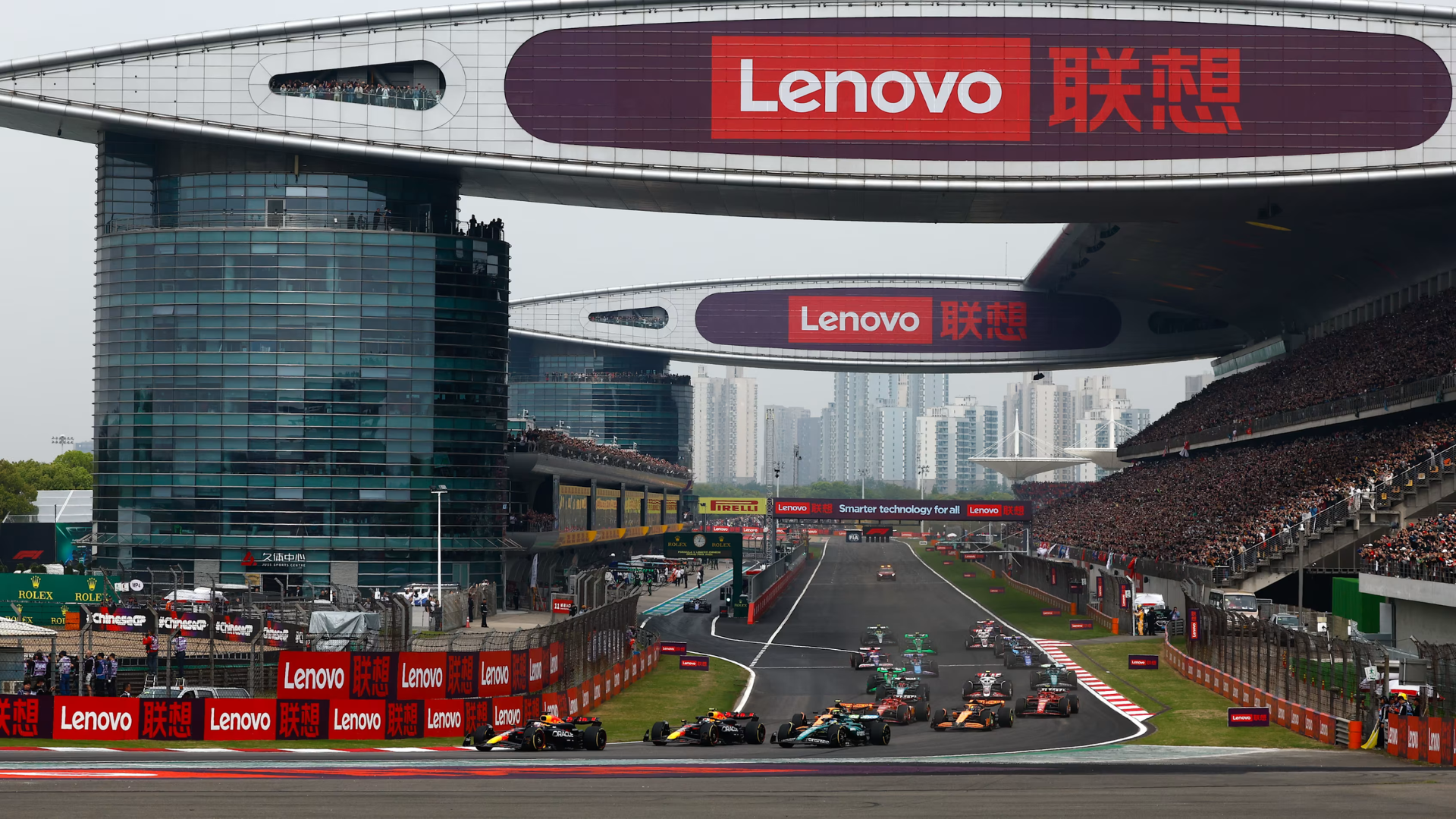
The Shanghai International Circuit is one of Formula One’s most distinctive modern tracks. The layout was designed to resemble the Chinese character “shang,” meaning upward or rising.
The circuit measures 5.451 km with 16 corners and combines three distinct technical challenges.
- The spiral opening complex (Turns 1–4)
A tightening right-hander that loads the front tyres for nearly seven seconds.
- The long back straight
Roughly 1.2 km, one of the longest full-throttle sections in F1.
- Heavy braking zones
Particularly into the Turn 14 hairpin, where many overtakes occur.
This combination explains why Shanghai consistently produces overtaking opportunities while also punishing poor tyre management.
Where the Chinese Grand Prix is won on the track
Fans often assume the decisive move at the Chinese GP happens at the Turn 14 hairpin because that is where most overtakes occur. But the real battle usually begins much earlier.
Turn 13 is the key corner.
Traditionally drivers must exit this long right-hander perfectly to maximise speed along the back straight. A strong exit can create a slipstream advantage of more than 15 km/h before the braking zone.
Because of that, teams often prioritise rear-end traction in setup rather than ultimate downforce. It is one of the few circuits where sacrificing mid-corner grip can actually improve overtaking potential.
This is why races in Shanghai frequently hinge on how well a car deploys energy and traction exiting Turn 13 rather than pure top speed.
How the 2026 Formula 1 regulations change the Shanghai challenge
The 2026 Formula 1 regulations introduce one of the biggest technical shifts in decades. Cars are lighter, aerodynamics are more flexible through active systems, and the hybrid power unit produces a much larger share of electric power.
Shanghai exaggerates those changes.
Energy deployment becomes critical
The long back straight demands careful ERS deployment management. With more electrical power available in 2026, drivers must decide where to spend it.
If they deploy too early on the straight, they become vulnerable at the end. If they deploy too late, they may never close the gap.
Active aero strategy
The shift away from traditional DRS toward active aerodynamic modes means the slipstream effect could become more complex.
Shanghai’s straight is long enough that even small drag differences between cars will be amplified.
Cooling and battery recovery
The sequence of medium-speed corners between Turns 6 and 8 generates heavy lateral loads while also providing energy harvesting opportunities. Cars that struggle with thermal management could quickly find themselves limiting power deployment.
In short, the 2026 Chinese GP could become one of the most technically demanding races on the calendar.
Chinese Grand Prix tyre strategy: Why degradation defines the race
Shanghai is notorious for front-left tyre degradation, largely because of the long opening corner sequence.
The front tyres remain loaded for an extended period through Turns 1 and 2, generating heat and surface wear. Drivers who push too aggressively early in a stint often pay the price later.
Typical strategic options include:
Two-stop strategy (most common)
Medium → Hard → Hard
Alternative strategy
Soft → Medium → Hard
The sprint format complicates matters further. Teams must manage tyre allocations across sprint and main race sessions while also maintaining flexibility.
That balance between tyre preservation and track position is why Shanghai regularly produces late-race overtakes.
Can Ferrari or Red Bull stop another Mercedes 1-2 in China?
Much of the paddock discussion heading into the Chinese GP weekend centres on Mercedes.
The Shanghai circuit has historically been a stronghold for the team. Their cars traditionally combine strong traction with efficient energy deployment, both crucial traits here. Not to mention their lead driver is called the tyre whisperer.
However, two rivals cannot be ignored.
Ferrari
Ferrari showed strong pace in sprint format races last season, highlighted by Hamilton’s sprint win in China. During the Australian Grand Prix, it was evident that with the correct setup, Ferrari could challenge Mercedes.
Their weakness time and time again is the strategy. Mistakes and bad strategical calls are extremely costly in Shanghai, so they have to have a clear plan heading into China.
Red Bull
Red Bull’s traditional strength lies in aerodynamic efficiency. That should help them on Shanghai’s long straight.
The problem is traction and reliability. The Turn 13 exit demands mechanical grip, and that has occasionally been a Red Bull weakness. Have they also found a solution to the potential reliability issues that both Red Bull drivers faced during the Australian Grand Prix?
Reliability concerns after Australia: Have teams solved the issues?
Early-season races often expose reliability problems, especially after major regulation changes.
The 2026 Formula 1 cars combine new power units, revised aerodynamics and heavier electrical systems.
Australia already highlighted several areas of concern:
- battery cooling
- power electronics reliability
- brake energy recovery systems
Shanghai’s long straights and heavy braking zones place enormous stress on both the electrical system and the braking hardware.
Teams that struggled with thermal management in Melbourne could face even bigger challenges here.
An iconic Chinese Grand Prix moment that still defines the circuit
Few races capture the spirit of the Chinese Grand Prix better than Daniel Ricciardo’s victory in 2018.
Starting sixth, Ricciardo used a late safety-car restart and a series of aggressive overtakes into Turn 14 to claim victory. The move on Valtteri Bottas in the hairpin remains one of the most memorable passes in modern F1.
That race perfectly illustrated why Shanghai rewards drivers willing to take risks under braking.
The track’s design encourages bold overtakes but punishes hesitation.
Why the 2026 Chinese Grand Prix could shape the entire season
The 2026 Chinese Grand Prix is more than just the second race of the year.
It is the first real stress test of the new Formula One regulations and the first sprint weekend where teams must balance limited preparation with aggressive strategy.
Shanghai exposes weaknesses brutally. Cars that struggle with tyre management, energy deployment or traction will be revealed quickly.
And that is why this race matters beyond the immediate result.
If one team emerges from the Chinese Weekend with a clear advantage in energy management and tyre wear, the rest of the grid is in serious trouble.
In a season defined by a new rulebook, Shanghai might already tell us who understands it best.
Recent Posts
-
Preview: The 2026 Chinese Grand Prix
-
2026 Australian Grand Prix Recap: Mercedes is the Benchmark
-
Drivers vs the New F1 Cars: What F1 Stars Really Think
-
2026 Australian Grand Prix Preview: Top Storylines & What to Expect
-
2026 Australian Grand Prix Betting Odds & Predictions
-
Australian Grand Prix Winners List (1985-2026)
-

Jonathan Wheatley Career: From Mechanic to Audi F1 Team Principal
-

Why is Toto Wolff the Richest Team Principal in F1?
-
Who is Winning the 2026 F1 Engine War?
-
Will Christian Horner Return to F1?