Why is F1 Returning to Turkey in 2027?
Last updated: 26/04/2026
Key Takeaways
- The Long-Term Contract: Formula 1 has officially inked a five-year agreement to race at Istanbul Park from 2027 through the 2031 season.
- Calendar Restructuring: To make room under the Concorde Agreement’s 24-race limit, the European calendar is seeing major rotations, freeing a permanent spot for Türkiye.
- A Push for Real Circuits: Paddock insiders and drivers successfully lobbied against the addition of more street tracks, demanding a return to high-aero, purpose-built venues.
- Massive Market Growth: Liberty Media data revealed a staggering 19 million active F1 fans in the Turkish market, making the deal a financial no-brainer.
When the news broke this week that Formula 1 is officially heading back to the crossroads of Europe and Asia, a collective sigh of relief washed over the paddock’s absolute purists. For the better part of the last half-decade, we’ve watched the sport’s calendar expand aggressively into flat, 90-degree street circuits wrapped around casinos and stadiums. But Istanbul Park is fundamentally different. It is a purpose-built, tire-shredding, high-speed rollercoaster.
After a fleeting, emergency return to the calendar during the pandemic-disrupted 2020 and 2021 seasons, fans, team principals, and drivers alike relentlessly campaigned for its permanent reinstatement. The wait is finally over. Formula 1 has announced a blockbuster five-year agreement to bring the FIA Formula One World Championship back to the iconic venue starting in 2027.
If you are looking at the intensely crowded 24-race schedule and wondering why is F1 returning to Turkey in 2027, the answer is not just about nostalgia. It lies in a perfect storm of vacant calendar slots, a booming local fanbase, the sport’s desperate need for stable racing venues, and a deliberate shift in track philosophy by Liberty Media.
Let’s take a deep, technical dive into the business, geopolitics, and track-side realities that convinced F1 CEO Stefano Domenicali to ink a half-decade contract with the Turkish Government.
Why is F1 Returning to Turkey in 2027? The Data-Driven Catalyst
Formula 1 is, above all else, a fiercely data-driven business. Liberty Media does not sign five-year contracts based on fond memories of races past; they sign them based on future market potential. When the Turkish Automobile Sports Federation (TOSFED) presented their bid for the 2027 slot to the FIA and Formula One Management (FOM), the metrics were simply too massive to ignore.
The sport has experienced an absolute explosion of engagement in the region. According to the official press release circulated through the paddock this weekend, there are currently an estimated 19 million active F1 fans in Türkiye. That is an astonishing market share for a country that hasn’t hosted a Grand Prix since 2021.
The digital footprint is even more compelling for Liberty Media’s youth-focused global strategy. Internal broadcast data showed a massive surge in regional social media metrics over the past twelve months. The sport recorded a 25% year-on-year growth in Instagram followers from Turkish accounts, alongside a staggering 107% increase in local YouTube viewership of F1 content.
FIA President Mohammed Ben Sulayem explicitly noted that Istanbul’s return underlines a shared commitment to expanding the championship in “dynamic markets.” Put simply, Turkey is no longer just a classic track loved by the drivers; it is a digital and broadcast goldmine that sponsors desperately want to tap into.
The Geopolitics of the 5-Year Turkish GP Contract
To fully understand the timing of this announcement, you have to look at the immediate logistical crisis Formula 1 faced earlier this season. The sudden cancellation of early-season flyaway races due to regional instability blew a massive hole in the 2026 schedule. F1 requires absolute logistical certainty. When a race drops off the calendar at the last minute, the financial ripple effects for teams, broadcasters, and freight partners like DHL are devastating.
Securing a five-year F1 Turkish GP contract through 2031 acts as a massive stabilizing force for the sport’s future logistics. Geographically positioned just outside the traditional European heartland, Istanbul Park offers world-class infrastructure and massive grandstands without the unpredictable logistical nightmares of newer, untested venues. Additionally, it’s logistically in a great position for teams and operators involved.
Furthermore, the deal is backed heavily by the highest levels of the Turkish government. President Recep Tayyip Erdoğan was reportedly personally involved in the push to secure the race. He highlighted that Formula 1 brings an unparalleled global spectacle and a wealthy, international demographic to the nation. With the full financial weight of the Ministry of Youth and Sports behind it, TOSFED has guaranteed a heavily upgraded paddock facility and packed grandstands come 2027.
Calendar Rotations: Finding Room Under the Cap
Even with the massive fanbase and iron-clad government funding, Formula 1 operates under a strict limit. The current Concorde Agreement mandates a maximum of 24 races per season to protect team personnel from severe burnout. The calendar was already completely full. So, whose slot did Türkiye actually take?
The 2027 season marks a massive structural shift in how Formula 1 manages its European footprint. To make room for the Turkish Grand Prix return, F1 is heavily leaning into a rotational calendar model for the first time in the modern era. Iconic European tracks that struggle to pay exorbitant hosting fees, such as Spa-Francorchamps and Barcelona, will begin alternating years to free up vital space in the summer months. There are different rumours rolling around currently on which GP will be replaced by the Turkish GP, but it’s very early to say which one as of yet.
Additionally, the Dutch Grand Prix at Zandvoort is officially leaving the schedule after an incredibly successful, but ultimately finite, run. Formula 1 essentially cleaned house to prioritize venues that can offer massive, modern facilities while delivering better on-track overtaking. Türkiye checked every single box on Stefano Domenicali’s clipboard.
A Pushback Against the Street Circuit Era
For the hardcore technical fans and the aerodynamicists on the pit wall, the return to Istanbul Park is a massive victory for pure racing. Over the past few years, the F1 calendar has become increasingly saturated with street circuits. While venues like Miami, Las Vegas, and Jeddah look undeniably stunning under the lights, their layout limitations often produce processional racing that relied entirely on DRS (Drag Reduction System) passes.
Stefano Domenicali directly addressed this rising criticism during the announcement. He explicitly stated that adding a pure racing track like Istanbul Park is a direct answer to fans complaining about the over-saturation of street races. The sport needed a circuit that actually tests the aerodynamic limits of a Formula 1 car.
Istanbul Park is a 5.338-kilometer masterpiece penned by legendary circuit architect Hermann Tilke. Built in 2005, it is universally beloved by the grid for its rhythmic, flowing nature. The Turn 1 left-hander aggressively drops away like Laguna Seca’s “Corkscrew,” instantly destabilizing the car’s rear end. The long back straight provides a genuine, slipstream-heavy overtaking opportunity into the heavy braking zone of Turn 12. But the real crown jewel, the reason engineers lose sleep, is found in the middle sector.
The Brutality of Turn 8
You cannot talk about the Turkish Grand Prix without bowing down to Turn 8. It is a terrifying, bumpy, multi-apex left-hander that sweeps downhill at increasing speed. Unlike a standard corner, Turn 8 features four distinct apexes strung together over a massive, sweeping radius that demands absolute perfection from the driver.
Because the Istanbul circuit runs counter-clockwise, drivers are subjected to severe, sustained lateral G-forces on the right side of their necks. For over five grueling seconds, drivers pull upward of 5G, physically battering their bodies while the front-right tire screams for mercy. It is a pure test of commitment, bravery, and aerodynamic load. Pirelli engineers often refer to it as the ultimate tire-killer on the calendar.
With the new 2026 technical regulations making the cars slightly nimbler and heavily reliant on active aerodynamics and ERS, seeing how these new F1 cars tackle Turn 8 will be the ultimate engineering puzzle. The active aero “Z-Mode” (high downforce configuration) will be pushed to its absolute structural limit through this sweeping curve.
Looking Back: Iconic Turkish Grand Prix Moments
For fans who joined the sport during the recent *Drive to Survive* boom, the golden era of Istanbul Park might be a bit of a blind spot. But the history books prove that this track guarantees chaos, strategic brilliance, and legendary paddock moments.
The 2010 Red Bull Civil War
If you want pure, unfiltered drama, look no further than the 2010 edition of the race. Sebastian Vettel and his Red Bull Racing teammate Mark Webber were locked in a bitter, high-stakes title fight. On lap 40, Vettel slipstreamed Webber down the massive back straight, jerking his car to the right to execute a high-speed overtake.
The two collided spectacularly at nearly 190 mph. The impact sent Vettel spinning wildly into the run-off area and into retirement, sparking one of the most toxic, high-profile teammate rivalries in modern motorsport history. The image of Vettel standing by his wrecked car, tapping his head to suggest Webber was crazy, is a moment burned into the retinas of every core F1 fan.
Hamilton’s 2020 Masterpiece
When the sport returned in 2020 on a freshly repaved, hyper-slippery surface in the pouring rain, the grip levels were virtually non-existent. While the rest of the grid spun wildly, including a heartbroken Max Verstappen, Lewis Hamilton delivered one of the greatest wet-weather drives in the history of the sport.
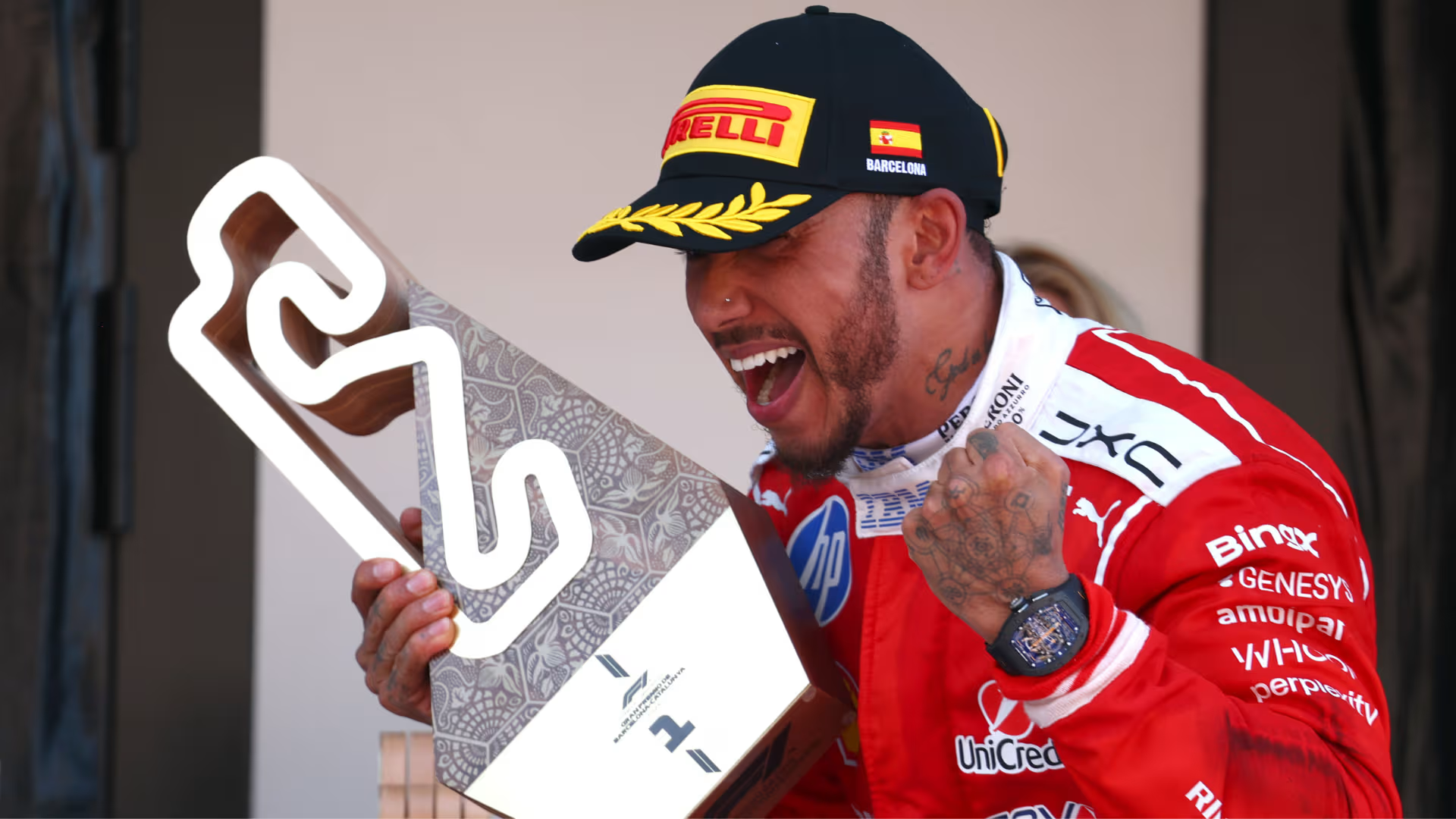
Managing a single set of intermediate tires until they were worn down to essentially bald slicks, Hamilton expertly modulated his throttle to find grip where no one else could. He crossed the line to win the race by over 30 seconds. That breathtaking victory famously sealed his seventh World Drivers’ Championship, tying Michael Schumacher’s all-time record in the most spectacular fashion imaginable.
With preparations and facility upgrades already well underway in the Akfırat district, the countdown to 2027 has officially begun. The world’s fastest cars are finally coming back to one of the world’s greatest race tracks, and the Formula 1 calendar is undeniably better for it.
People Also Ask (FAQ)
Who won the last Formula 1 Turkish Grand Prix?
The last Formula 1 Turkish Grand Prix was held in 2021 and was won by Valtteri Bottas, driving for Mercedes. He dominated the race in damp conditions. The year prior, in 2020, his teammate Lewis Hamilton famously won the race in treacherous wet conditions to secure his record-tying seventh World Championship.
Will the Istanbul Park track be repaved for 2027?
While the official details of track upgrades are still being finalized, the Turkish Automobile Sports Federation (TOSFED) has promised significant facility upgrades. Following the notoriously slippery 2020 race, the track surface was heavily water-blasted in 2021 to expose the aggregate and improve grip. For 2027, the FIA will likely require minor resurfacing and kerb updates to accommodate the new 2026 ground-effect regulations.
How long is the new Turkish Grand Prix contract?
Formula 1 has signed an initial five-year agreement with the Turkish Ministry of Youth and Sports and the local promoters. The contract ensures that the Turkish Grand Prix will remain a permanent fixture on the F1 calendar from the beginning of the 2027 season through the end of the 2031 season.