
2026 Australian Grand Prix Recap: Mercedes Is the Benchmark
Last updated: 08/03/2026
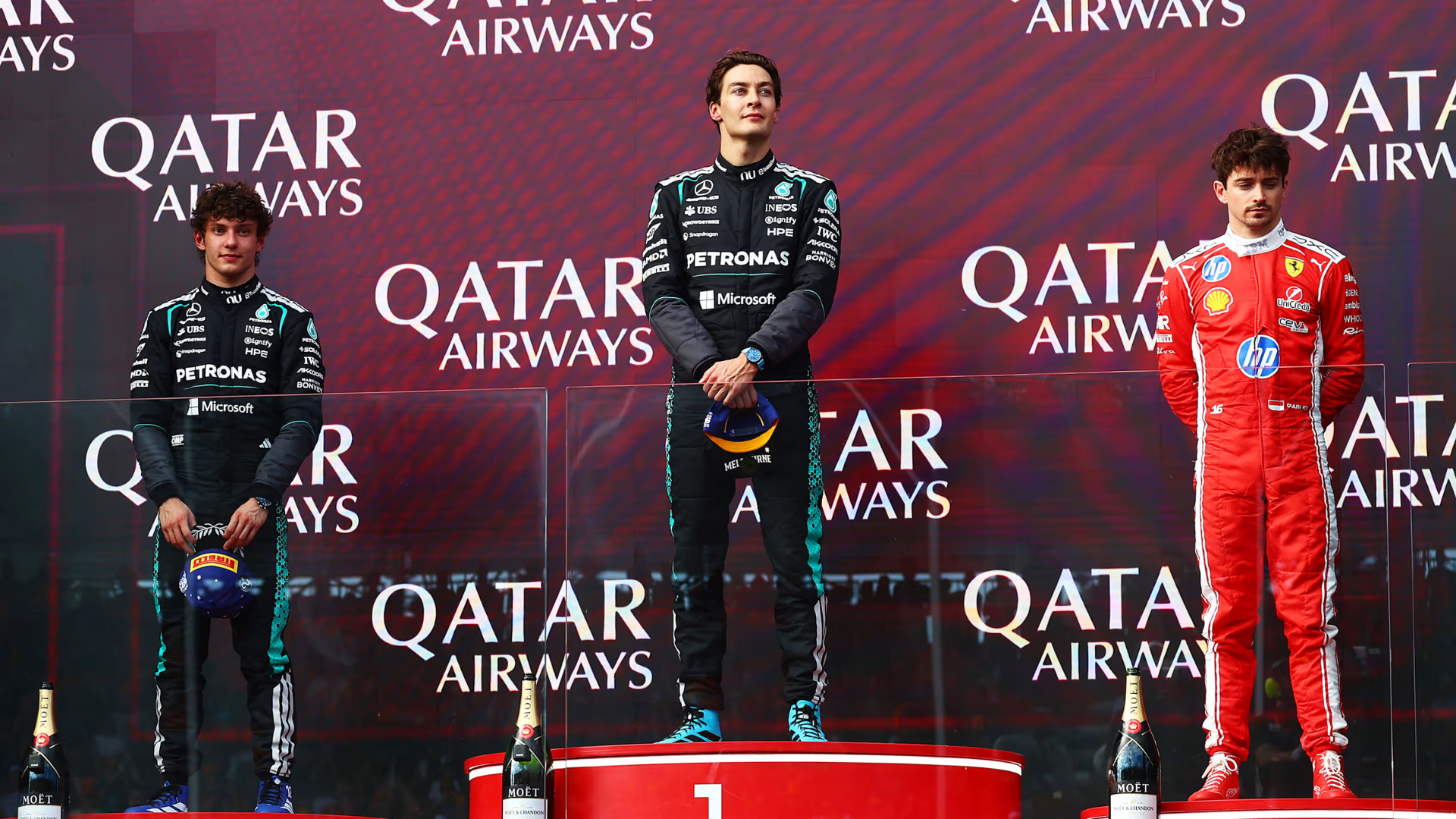
The short answer from the 2026 Australian Grand Prix Recap is simple: Mercedes currently sets the performance standard in Formula 1. George Russell’s win and Kimi Antonelli’s second place were not just the result of clean execution. They reflected a car, power unit, and operational approach that understood the new 2026 regulations better than anyone else at Albert Park.
The 2026 Australian Grand Prix at Melbourne’s Albert Park circuit therefore mattered far beyond one race result. It was the first real test of a completely new technical era in F1, and the early Australian GP results suggest Mercedes has interpreted the rules more effectively than its rivals.
The 2026 Australian Grand Prix Recap and Results
2026 Australian Grand Prix Qualifying Results
| Pos | Driver | Team | Q3 Time |
|---|---|---|---|
| 1 | George Russell | MMercedes |
1:18.518 |
| 2 | Kimi Antonelli | MMercedes |
1:18.811 |
| 3 | Isack Hadjar | RBRed Bull Racing |
1:19.303 |
| 4 | Charles Leclerc | FFerrari |
1:19.327 |
| 5 | Oscar Piastri | MCLMcLaren |
1:19.380 |
| 6 | Lando Norris | MCLMcLaren |
1:19.475 |
| 7 | Lewis Hamilton | FFerrari |
1:19.478 |
| 8 | Liam Lawson | RBRacing Bulls |
1:19.994 |
| 9 | Arvid Lindblad | RBRacing Bulls |
1:21.247 |
| 10 | Gabriel Bortoleto | AUAudi |
No Time |
2026 Australian Grand Prix Race Results
| Pos | Driver | Team | Time / Gap | Points |
|---|---|---|---|---|
| 1 | George Russell | MMercedes |
1:23:06.801 | 25 |
| 2 | Kimi Antonelli | MMercedes |
+2.974s | 18 |
| 3 | Charles Leclerc | FFerrari |
+15.519s | 15 |
| 4 | Lewis Hamilton | FFerrari |
+16.144s | 12 |
| 5 | Lando Norris | MCLMcLaren |
+51.741s | 10 |
| 6 | Max Verstappen Fastest Lap | RBRed Bull Racing |
+54.617s | 8 |
| 7 | Oliver Bearman | HHaas |
+1 Lap | 6 |
| 8 | Arvid Lindblad | RBRacing Bulls |
+1 Lap | 4 |
| 9 | Gabriel Bortoleto | AUAudi |
+1 Lap | 2 |
| 10 | Pierre Gasly | AAlpine |
+1 Lap | 1 |
Fastest Lap: Max Verstappen – Red Bull Racing (1.22.091)
The 2026 Australian Grand Prix Recap: Why Mercedes Was Untouchable
Mercedes did not win in Melbourne because of a lucky safety car or an aggressive strategy call. They won because their package appears inherently better suited to the demands of the 2026 regulations.
The W17 combined three advantages that proved decisive across the 2026 Melbourne weekend. First was power unit efficiency under the new hybrid balance. Second was superior energy deployment management. Third was a chassis that remained stable while switching between the active aerodynamic modes that now define modern Formula 1.
These elements rarely appear on timing sheets, but they decide races in a new regulation cycle.
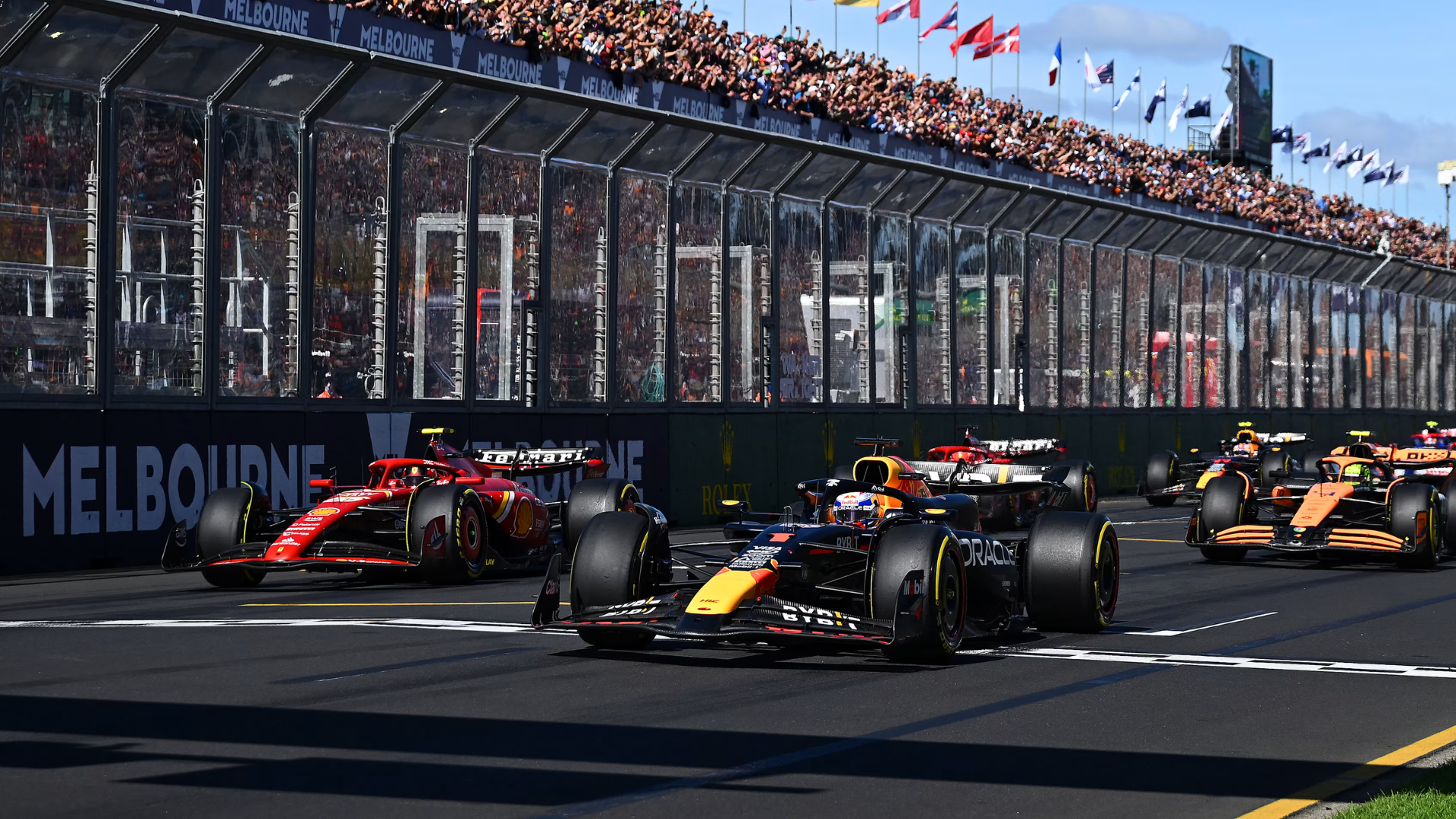
Ferrari briefly led early in Melbourne, yet the pace gap became clear once Mercedes settled into race rhythm.
What Makes the 2026 Cars So Different?
To understand the Australian GP results, it is important to understand the new regulatory environment.
The 2026 rules represent the largest power unit change since the hybrid era began in 2014. The combustion engine produces less power while the electrical system has expanded dramatically. The MGU-K now delivers up to 350 kW, meaning roughly half of the total power output comes from electric deployment.
At the same time, Formula 1 introduced active aerodynamics. Drivers can switch between high-downforce “corner mode” and low-drag “straight mode” configurations during the lap.
This fundamentally changes how drivers manage speed, braking, and battery deployment. The car is no longer a static aerodynamic platform. It is an adjustable system that must constantly balance efficiency and grip.
Teams that understand this interaction early will dominate the opening phase of the regulation cycle.
Mercedes appears to be one of them.
The Compression Ratio Debate Reveals the Real Competitive Edge
One of the most discussed topics before the Australian GP in Melbourne was the compression ratio controversy involving Mercedes.
Rivals suspected that the manufacturer had discovered a way to maintain higher effective compression at operating temperatures while still passing the FIA’s static test limits. Mercedes argued their design simply prevented the normal efficiency loss that occurs as engines heat up.
The FIA eventually ruled that a new measurement protocol would take effect mid-season, meaning current power units remain legal for the first part of the year.
Why does this matter?
Because in a hybrid system where electrical deployment is dominant, combustion efficiency becomes the foundation for everything else. A more efficient engine allows the electrical system to be used more aggressively.
That advantage showed up clearly in the Australian Grand Prix results, where the Mercedes-powered cars maintained strong deployment late in stints.
Ferrari’s Real Problem Was Strategy, Not Pace
One of the most common fan reactions after the results in Melbourne was that Ferrari simply lacked the pace to beat Mercedes.
That interpretation is too simplistic.
The Ferrari SF-26 demonstrated excellent launch performance and competitive one-lap speed. Charles Leclerc’s start, jumping from fourth to first, proved the car’s acceleration advantage under low-speed conditions (as well as a bad start by Mercedes’ drivers)
Ferrari’s real mistake came during the Virtual Safety Car triggered by Isack Hadjar’s retirement.
Mercedes immediately switched both cars onto a one-stop strategy. Ferrari chose track position instead, believing the hard tyre would struggle to reach the finish.
That decision cost them control of the race.
Once Russell stopped early, the pace difference during the second stint allowed him to erase Ferrari’s advantage quickly. When Ferrari eventually pitted under green flag conditions, the strategic battle was effectively over.
The Australian GP results therefore reflected execution differences as much as raw performance.
Max Verstappen’s Recovery Hides Red Bull’s Bigger Problem
Max Verstappen finishing sixth after starting last looks impressive on paper. In isolation, it was a strong recovery drive.
But it also masked a worrying reality for Red Bull.
The RB22 showed inconsistent energy deployment throughout the weekend. Rookie teammate Isack Hadjar reported unpredictable braking behaviour caused by fluctuating battery harvesting.
That type of instability suggests deeper integration problems between the new power unit architecture and the chassis.
Hadjar’s retirement with a power unit fire only reinforced the concern.
If Mercedes mastered the new energy systems early, Red Bull appears to still be learning how to manage them.
Audi’s Debut Shows Why the Grid Expansion Matters
The 2026 Australian Grand Prix also marked the long-awaited arrival of Audi as a full works team.
Historically, new Formula 1 manufacturers struggle for several seasons before reaching competitiveness. Audi’s ninth-place finish with Gabriel Bortoleto suggests a different trajectory.
The car looked stable, efficient, and reasonably competitive within the midfield group.
That result matters because the 2026 rules were specifically designed to attract new manufacturers through simpler power units and sustainable fuels.
If Audi can score points immediately, the new regulations have achieved part of their goal.
McLaren Leaves Melbourne With Mixed Signals
McLaren’s results in Melbourne ended up being defined by two very different stories. Oscar Piastri’s race ended before it began after a costly crash on the reconnaissance lap to the grid. The Australian lost the rear over the Turn 4 exit kerb on cold tyres and hit the barriers, turning what should have been a strong home race at Albert Park into a DNS.
That left Lando Norris as McLaren’s sole representative, and his drive to fifth quietly became one of the most disciplined performances in the 2026 Australian Grand Prix. Norris avoided the early chaos, managed energy deployment effectively, and resisted sustained pressure from a recovering Max Verstappen in the final stint.
The result was not spectacular, but in the context of the Australian GP results, it demonstrated that McLaren’s car remains competitive even if it currently lacks the outright pace to challenge Mercedes or Ferrari.
Not Everyone Left Melbourne With Momentum
While the Australian GP results highlighted strong performances from Mercedes, Ferrari and several rookies, a few teams quietly endured difficult weekends that should not be ignored.
Aston Martin’s problems were the most visible. The team struggled with severe vibration issues linked to their new power unit, a problem serious enough that drivers reported numbness and mechanical components were shaking loose during running. The issue severely limited performance and reliability throughout the weekend, leaving Aston Martin nowhere near the competitive midfield.
Williams were another team that left Albert Park with more questions than answers. There had been significant pre-season discussion about their long-term focus on the new regulations, yet the race itself was relatively anonymous. The car lacked the outright pace to fight for points consistently, suggesting that the team’s much-talked-about 2026 project may still need time to translate into performance on track.
Cadillac’s debut was more nuanced. The American manufacturer did not threaten the top ten, but completing the race weekend and gathering real-world data in its first Formula one race in Australia appearance was arguably the most important outcome. For a brand-new operation learning the complexities of Formula 1 logistics, hybrid power management and race execution, simply finishing the event provided invaluable information for the development cycle ahead.
Taken together, these quieter storylines reinforce a larger truth about the Australian Grand Prix. The new regulatory era has widened the learning curve across the grid. Some teams have already found a competitive baseline. Others are still trying to understand the machinery they have built.
And that gap could define the early phase of the season just as much as outright speed.
The Human Factor Still Matters in a New Technical Era
Regulation changes often create the illusion that technology alone determines results.
The Melbourne weekend reminded everyone that drivers still shape the narrative.
Russell managed the race with precision, avoiding unnecessary tyre stress while maintaining consistent energy deployment.
Antonelli’s recovery after a poor start showed remarkable composure for a junior driver with high expectations.
Meanwhile, Ferrari’s drivers pushed aggressively to compensate for strategy disadvantages.
In other words, even in the most technologically complex era in Formula 1, execution remains decisive.
What the Australian Grand Prix Results Tell Us About the Season
Early races in a new regulation cycle often reveal the competitive hierarchy faster than fans expect.
The Australian Grand Prix results suggest three immediate conclusions.
Mercedes currently has the most complete package.
Ferrari has the pace to challenge but needs sharper strategic decisions.
Red Bull faces integration and reliability questions.
The midfield battle appears wide open, with teams like Haas, Racing Bulls, and Audi already showing competitiveness. Also, the only rookie on the grid, Arvid Lindblad, showed great composure by finishing P9 in his first F1 race ever.
That diversity of performance could produce unpredictable races in the coming months.
Conclusion: Why the 2026 Australian Grand Prix Recap Matters for the Future
The 2026 Australian Grand Prix Recap is important not because of who won one race, but because it revealed how the new Formula 1 era may unfold.
Whenever the sport introduces major technical changes, the team that interprets them best at the beginning often defines the competitive landscape for years.
Right now, that team appears to be Mercedes. Rivals will develop quickly. Ferrari will refine strategy. Red Bull will solve reliability issues. Audi and Cadillac will grow into the championship.
But the lesson from Australia is clear. The Silver Arrows have established the early benchmark in this new generation of Formula One racing.
And history suggests that catching a team that starts a regulation cycle ahead is one of the hardest challenges in Formula 1.
Recent Posts
-
2026 Australian Grand Prix Recap: Mercedes is the Benchmark
-
Drivers vs the New F1 Cars: What F1 Stars Really Think
-
2026 Australian Grand Prix Preview: Top Storylines & What to Expect
-
2026 Australian Grand Prix Betting Odds & Predictions
-
Australian Grand Prix Winners List (1985-2026)
-

Jonathan Wheatley Career: From Mechanic to Audi F1 Team Principal
-
Why is Toto Wolff the Richest Team Principal in F1?
-
Who is Winning the 2026 F1 Engine War?
-
Will Christian Horner Return to F1?
-
The Netflix Effect on F1: A Data Analysis of America’s Boom and Its Ceiling