
2026 Australian Grand Prix Preview: Top Storylines & What to Expect
Last updated: 05/03/2026
The 2026 Australian Grand Prix is less about who arrived quickest in testing and more about which team truly understands the sport’s new technical framework. The combination of new power units, active aerodynamics and revised energy deployment means Albert Park will immediately reward teams that manage systems and new regulations well rather than simply chasing peak lap time.
Early signals from Bahrain suggest Mercedes and Ferrari may have the most coherent packages, while reigning champions McLaren face the familiar challenge of developing through the season. Meanwhile a new rookie, new teams and unresolved technical questions add another layer of uncertainty to the Australian GP season opener in Melbourne.
The reality is simple. The F1 Australian Grand Prix will act as the first real stress test of the new era & the biggest regulation change in the history of Formula 1.
Why Albert Park still produces unpredictable racing
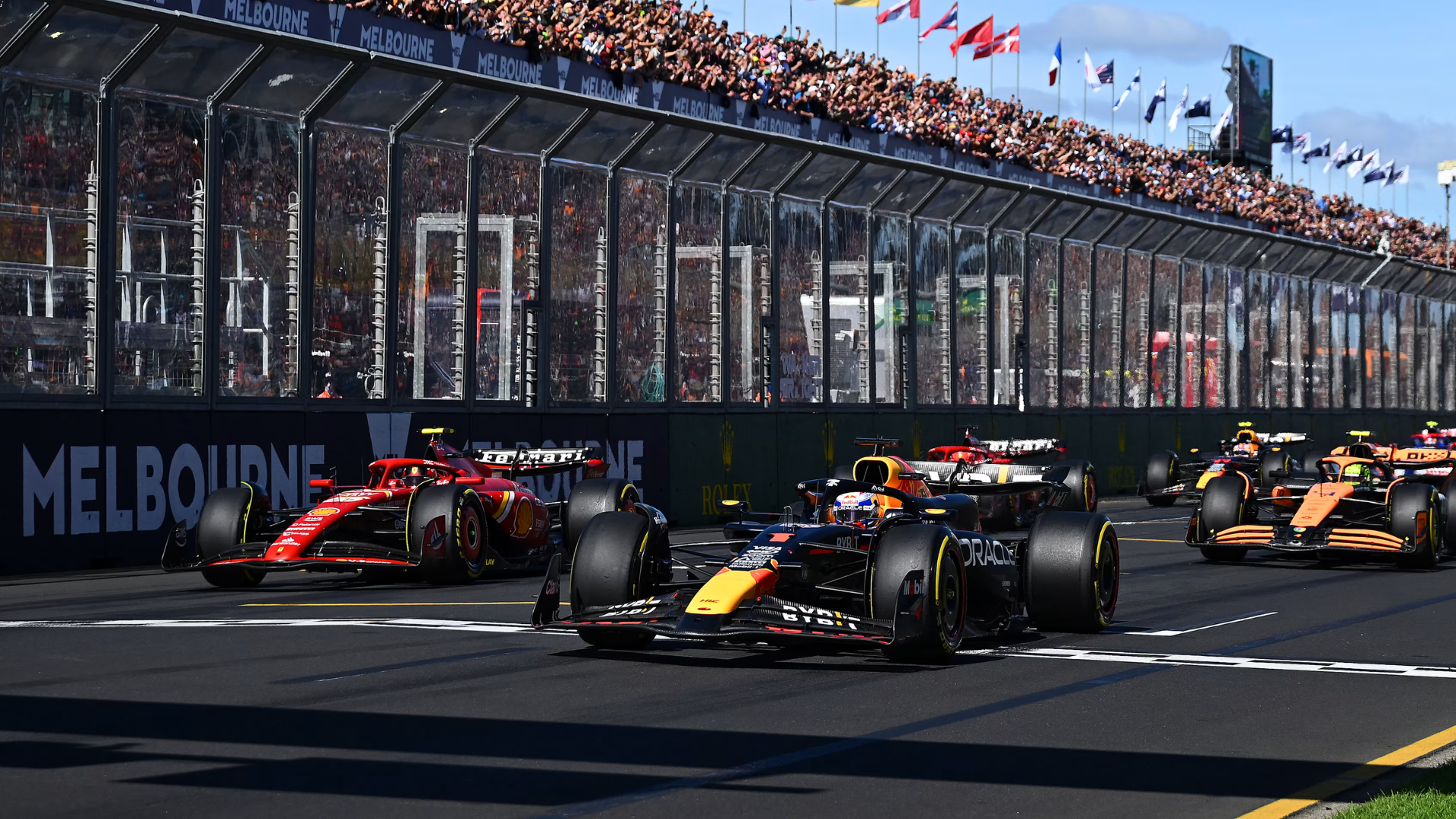
The Albert Park circuit is often described as a street track, but the label hides how unusual it actually is. The layout is a hybrid between a temporary street circuit and a permanent parkland track, combining fast flowing sections with low grip surfaces and evolving conditions throughout the weekend.
At 5.278 km with 14 corners, the Australian Grand Prix layout rewards efficiency and confidence. Long acceleration zones mean cars must carry strong energy deployment, while medium speed direction changes punish unstable aerodynamic balance.
Grip evolution also plays a central role in Australia. Because the roads are open to public traffic for most of the year, the track surface begins the weekend slippery and progressively gains grip as rubber builds up. That dynamic alone can reshuffle the order between Friday practice and qualifying.
Weather only amplifies this uncertainty. March conditions in Melbourne regularly swing between warm sunshine and cooler cloudy spells, sometimes with brief rain showers. Teams that only understand their tyre performance in a narrow temperature window often struggle here.
That is one reason the Australian GP tends to produce chaotic races. Strategy models often collapse when track grip changes quickly or a Safety Car interrupts the flow of the race.
How the 2026 regulation change challenges the Australian Grand Prix
Melbourne is the first race under a completely revised Formula 1 technical framework. New hybrid power units, increased electrical deployment and active aerodynamics have changed the way performance is generated across a lap.
Under the new regulations, electrical power has increased significantly while aerodynamic drag can vary through active wing modes. This transforms the balance between cornering speed and straight line acceleration.
In simple terms, the new system works like this.
Active aerodynamic elements allow the car to switch into a low drag configuration on designated straights, reducing resistance and increasing top speed. At the same time, drivers manage electrical deployment that provides bursts of extra acceleration when overtaking opportunities appear.
The result is that pace is no longer only about mechanical grip or aerodynamic efficiency. It is also about how effectively a team manages the car’s energy budget over an entire lap.
Albert Park exposes this dynamic more clearly than many circuits. The Melbourne Street Circuit layout includes several long acceleration zones where electrical deployment becomes decisive. If a team spends too much energy early in the lap, it may arrive at the next straight with little advantage left.
That complexity explains why engineers across the paddock describe the new era as an energy management championship as much as a driving one.
Are Mercedes and Ferrari already leading the development race?
Mercedes focused heavily on mileage and baseline understanding. That approach often pays dividends in regulation resets because reliability and system integration become the first performance differentiators. A car that runs consistently allows engineers to build data and refine energy deployment strategies quickly.
Ferrari appears strong for a slightly different reason. Their early work suggested a balanced package with stable aerodynamic behaviour and strong straight line performance. That combination could prove valuable at Albert Park, where efficiency matters as much as outright cornering speed.
The reason these teams may take the lead early in Australia is structural. Both organisations entered the regulation cycle with significant investment in new power unit architecture and simulation tools. Both teams supply engines to the majority of Formula 1 teams.
However, early favourites do not guarantee early victories. Regulation changes frequently reward the teams that understand development direction fastest rather than those who arrive with the quickest starting point.
That nuance is why many drivers remain cautious when discussing the competitive order.
Can McLaren and Lando Norris defend their titles?
McLaren enter the Australian Grand Prix weekend as reigning back to back constructor world champions, with Lando Norris defending his drivers’ title. Yet history suggests defending champions rarely dominate immediately after major regulation changes.
The reason is simple. When the rulebook changes, the competitive reset often rewards a team that interprets the new concepts more accurately rather than the one that mastered the previous generation of cars.
McLaren’s strength over the last few seasons has been relentless development. Their engineering structure proved highly effective at refining aerodynamic packages and unlocking performance during the year.
But the 2026 cars place greater emphasis on system integration between power unit, aerodynamics and energy management. That shift may initially benefit teams with stronger power unit partnerships or deeper hybrid expertise.
For Norris, the challenge is therefore strategic rather than psychological. His driving style is built around precision and tyre management, both valuable traits in the new environment.
The real question for the Australian GP is whether McLaren have already found the correct development philosophy for the new rules or whether they will once again rely on mid season progress to close any early gap.
Max Verstappen, Isack Hadjar and the Red Bull transition
Red Bull begin 2026 in a transitional phase. The team has moved into a new era with its Red Bull Ford power unit project, representing one of the most ambitious engineering shifts in modern Formula 1.
For Max Verstappen, that shift creates both opportunity and uncertainty. Few drivers are better at extracting performance from imperfect machinery, but the early phase of a power unit programme often involves reliability and optimisation challenges.
Isack Hadjar enters this environment as Verstappen’s new team mate. That dynamic places immediate pressure on the rookie because the benchmark is arguably the most demanding in the sport. Hadjar had an impressive rookie season, but can he beat the curse of the Red Bull second seat? That is the question we’ll find the answer to very soon.
At the same time another young talent, Arvid Lindblad, enters Formula 1 as the grid’s only rookie, joining Racing Bulls. His arrival reflects a wider trend in the sport, where teams increasingly value drivers who can quickly adapt to complex energy management systems. As the saying goes, it’s hard to teach an old dog new tricks.
Albert Park will be a particularly demanding debut. The circuit’s evolving grip levels and fast direction changes require confidence that usually comes only with experience.
Yet rookies occasionally benefit from regulation resets. Without years of habits formed under previous rules, younger drivers sometimes adapt faster to new technical behaviour.
Are Aston Martin facing deeper problems than expected?
Reports from testing suggested the team experienced vibration issues related to their power unit integration. Problems affecting battery reliability and energy deployment are particularly damaging in the 2026 rules because electrical power plays such a central role in performance.
Even a small limitation in battery operation can compromise an entire lap. Energy that cannot be harvested or deployed correctly directly reduces acceleration on the circuit’s longest straights.
Aston Martin still possesses strong technical leadership and significant resources, but the early phase of a regulation change can magnify integration challenges.
If the team cannot operate its power unit system freely, development upgrades may take longer to deliver meaningful gains.
That possibility explains why many analysts view the Australian opener as a critical early indicator of Aston Martin’s direction this season.
Why Williams could become the surprise contender
Williams enters the Melbourne weekend in a quieter but intriguing position. Under team principal James Vowles the organisation has focused heavily on rebuilding its internal processes and technical infrastructure.
This approach rarely produces instant results, but it often pays off during regulation changes when efficiency and preparation become decisive.
Williams have steadily improved their operational consistency over the past seasons. Stronger simulation tools, clearer engineering structures and improved driver feedback systems are beginning to show measurable progress. Also, having a strong driver pairing definitely helps.
However, expectations remain cautious. The team acknowledges its car may still carry weight disadvantages compared with the leading teams.
Weight matters more in the 2026 cars because it directly influences energy consumption and acceleration efficiency. A heavier car demands more electrical deployment to achieve similar performance. It is also worth mentioning that if Williams gets off to a rocky start, the shareholders will start directing questions towards James Vowles. Their whole gameplan for the past few seasons has been oriented towards the new regulation cycle and investors are looking for results.
That said, the unpredictable nature of the Australian GP often rewards teams that maximise reliability and strategy execution. Williams could capitalize on early season chaos if front running teams encounter technical or strategic problems.
Will Audi and Cadillac reshape the Formula 1 grid?
The 2026 season also marks the arrival of new manufacturers, adding fresh dynamics to the sport.
Audi took over the Sauber entry as a full works team, launching their first modern Formula 1 project. Building a competitive power unit and chassis simultaneously is one of the most complex tasks in motorsport, which means early progress may come gradually.
Cadillac joins the grid as the eleventh team, bringing significant American investment and attention to Albert Park and the wider championship.
New teams rarely compete for victories immediately. Their early goals focus on reliability, operational learning and establishing a stable technical foundation.
However, the first race weekend of a new regulation cycle can produce unusual results. Established teams occasionally stumble while new projects benefit from conservative engineering approaches that prioritise reliability.
In Melbourne, simply finishing the race cleanly can sometimes translate into points.
Why the 2026 Australian Grand Prix matters beyond Melbourne
The 2026 Australian Grand Prix represents more than a traditional season opener. It is the first real competitive benchmark for a new Formula 1 philosophy built around hybrid energy deployment and adaptable aerodynamics.
The teams that understand this framework earliest will shape the competitive narrative of the entire regulation cycle. Development direction, political debates over technical interpretation and even driver confidence often emerge from the first races.
Albert Park therefore serves as a diagnostic tool for the sport itself. The results in Melbourne will reveal which organisations have built adaptable engineering platforms and which may need months to catch up.
Those early signals matter because Formula 1 development rarely resets mid cycle. The teams that identify the correct technical philosophy first often compound that advantage over several seasons.
That is why the 2026 Australian Grand Prix will resonate long after the podium celebrations end in Melbourne.
Recent Posts
-
2026 Australian Grand Prix Preview: Top Storylines & What to Expect
-
2026 Australian Grand Prix Betting Odds & Predictions
-
Australian Grand Prix Winners List (1985-2026)
-

Jonathan Wheatley Career: From Mechanic to Audi F1 Team Principal
-
Why is Toto Wolff the Richest Team Principal in F1?
-
Who is Winning the 2026 F1 Engine War?
-
Will Christian Horner Return to F1?
-
The Netflix Effect on F1: A Data Analysis of America’s Boom and Its Ceiling
-
How to Become an F1 Driver?
-
Will Kalle Rovanperä Drive in Formula 1?